
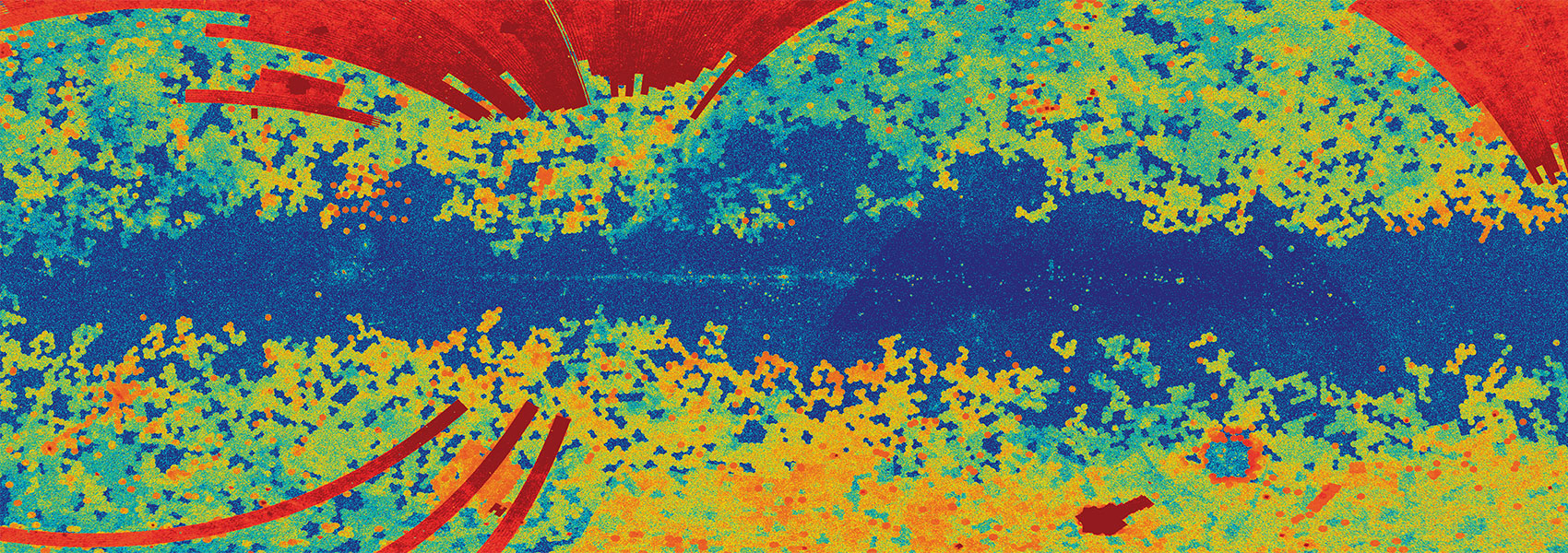
Parallel Application of Slitless Spectroscopy to Analyze Galaxy Evolution (PASSAGE): Survey Overview
November 2025 • 2025ApJ...993..152M
Abstract • During the second half of Cycle 1 of the James Webb Space Telescope (JWST), we conducted the Parallel Application of Slitless Spectroscopy to Analyze Galaxy Evolution (PASSAGE) program. PASSAGE received the largest allocation of JWST observing time in Cycle 1, 591 hr of NIRISS observations to obtain direct near-IR imaging and slitless spectroscopy. About two-thirds of this was ultimately executed, to observe 63 high-latitude fields in pure-parallel mode. These have provided more than 10,000 near-infrared grism spectrograms of faint galaxies. PASSAGE brings unique advantages in studying galaxy evolution: (a) Unbiased spectroscopic search, without prior photometric preselection. By including the typical galaxies which have low masses and strong emission lines, slitless spectroscopy is the indispensable complement to any pretargeted spectroscopy. (b) The combination of several dozen independent fields to overcome cosmic variance. (c) Near-infrared spectral coverage, spanning a wide wavelength range of up to 1.0 to 2.3 μm, with minimal wavelength gaps, to measure multiple diagnostic rest-frame optical lines, minimizing sensitivity to dust reddening. (d) JWST's unprecedented spatial resolution, in some cases using two orthogonal grism orientations, to overcome contamination due to blending of overlapping spectra. (e) Discovery of rare bright objects especially for detailed JWST follow-up. PASSAGE data are public immediately, and our team plans to deliver fully processed high-level data products. In this PASSAGE overview, we describe the survey and data quality, and present examples of these accomplishments in several areas of current interest in the evolution of emission-line galaxy properties, particularly at low masses.
Links
IPAC Authors
(alphabetical)
Assistant Scientist
Associate Scientist
Scientific Analyst
Assistant Scientist

Assistant Scientist
Senior Scientist