Greg Walth
Staff Scientist

Greg Walth works at IPAC’s Roman Science Support Center where he is developing the pipeline to optimize NASA’s Nancy Grace Roman Space Telescope’s Wide Field Instrument (WFI) spectral data for scientists who will use the data to study the expansion of the Universe and many other astronomical mysteries.
When did you first become interested in astronomy/space, and why?
As far as I can remember I have always been interested in space. While science fiction movies such as Star Wars and 2001: A Space Odyssey, played a large role in increasing this interest, growing up in Antelope Valley was probably the biggest influence. Antelope Valley is a major aerospace hub and I used to watch the SR-71 fly over my elementary school. I have many memories of the Space Shuttle landing at Edwards Air Force Base. My family was heavily involved in aerospace; my father was an avionics test engineer that worked on several aircraft for Lockheed, Northrup, and Rockwell and my grandfather specialized on the structural tests on the Space Shuttle. Both my mother and grandmother spent a number of years working in aerospace as well.
At one point, my family picked up a Tasco telescope to try to observe Halley's Comet, but I didn’t really become interested in using a telescope until my high school years. When I started using the telescope more regularly, I discovered the optics were damaged, and as a result we bought a bigger and better Celestron telescope that helped develop my interest in amateur astronomy.
What was your career path to astronomy like?
In school, most of my interests were focused around fine art. I enjoyed drawing and painting space, and technical-related themes. To some people my transition to a technical field seemed strange, however, I had always imagined following in my father's footsteps and becoming an aerospace engineer. Many of the Mars missions were inspirational to me and I knew I wanted to work on something similar. My family couldn't afford to pay for a four-year college education, so I started my journey at Antelope Valley Community College, working toward an engineering degree with the goal of transferring to a four-year university.
While at community college, I joined the astronomy club and started practicing amateur astronomy. My interest was piqued, and I decided to take one of the limited number of astronomy courses offered. It was eye-opening for me. So much of the universe that I never knew before…this was the next spark for me. I wanted to learn more.
I worked a few jobs as a research assistant for astronomy and particle physics professors and postdocs during and after completing my undergraduate degree at UCLA, and then at Lowell Observatory in Northern Arizona, until I landed at Carnegie Observatories in Pasadena. There, I helped build pipelines for the Magellan telescopes at Las Campanas Observatory.
My Carnegie position gave me my first opportunity to visit a large telescope. I went on an observing run with my supervisor and it was amazing. I was awestruck from the experience, both from seeing the southern sky for the first time (seeing, for example, the Magellanic Clouds) as well as from having my first professional observing experience. This was the first time in my life I knew what I wanted to do, and I knew I needed to find a way back. The mentorship I received from the staff and postdocs at Carnegie was instrumental in helping me along this path, and soon after I was headed to graduate school to pursue my Ph.D. in astrophysics.
What was your path to IPAC?
In graduate school at the University of Arizona, I realized that I wanted to be in a role where I supported a telescope or mission, which was partly inspired by my experience at Carnegie. Near the end of graduate school, I had my first experience with this when I helped commission the second LUCI near-infrared spectrograph on the Large Binocular Telescope. I discovered I really enjoy solving technical instrumental problems, creating software that could process the data from the telescope, and building tools that are useful to people in the field.
I took my first postdoc with this path in mind, helping to develop the reduction pipeline for the Infrared Imaging Spectrograph (IRIS) instrument on the Thirty Meter Telescope. In this role, I picked up several skills I use today. One of the first things I did was simulate spectral images of some of the astronomical scenes we could observe with IRIS. I dived into designing the initial pipeline and dug into the details of the algorithms used for integral field spectroscopy, which culminated with writing my own exposure time calculator for IRIS that was used in many of the white papers written for the Astro2020 Decadal Survey report. This work later helped to materialize the Liger instrument on the Keck telescopes in Hawai’i.
In my next postdoc, I worked mainly on a science project involving the circumgalactic medium. One program I was helping to support also had parallel observations with HST WFC3-IR slitless grism spectroscopy, and the person leading this component was busy trying to get JWST ready for launch. I had done some processing of slitless spectra back in graduate school, but I had never had a leading role for such a large program. I volunteered to lead the effort in processing the spectra and creating the catalogs for these parallel fields. I learned quite a lot about slitless spectroscopy (where every object in the imaged area creates its own spectrum, possibly overlapping with objects on the same row of the detector) from this experience, and it helped prepare me for my role at IPAC. I applied for a Euclid position at IPAC and was then encouraged by an IPAC scientist to apply for the Roman position.
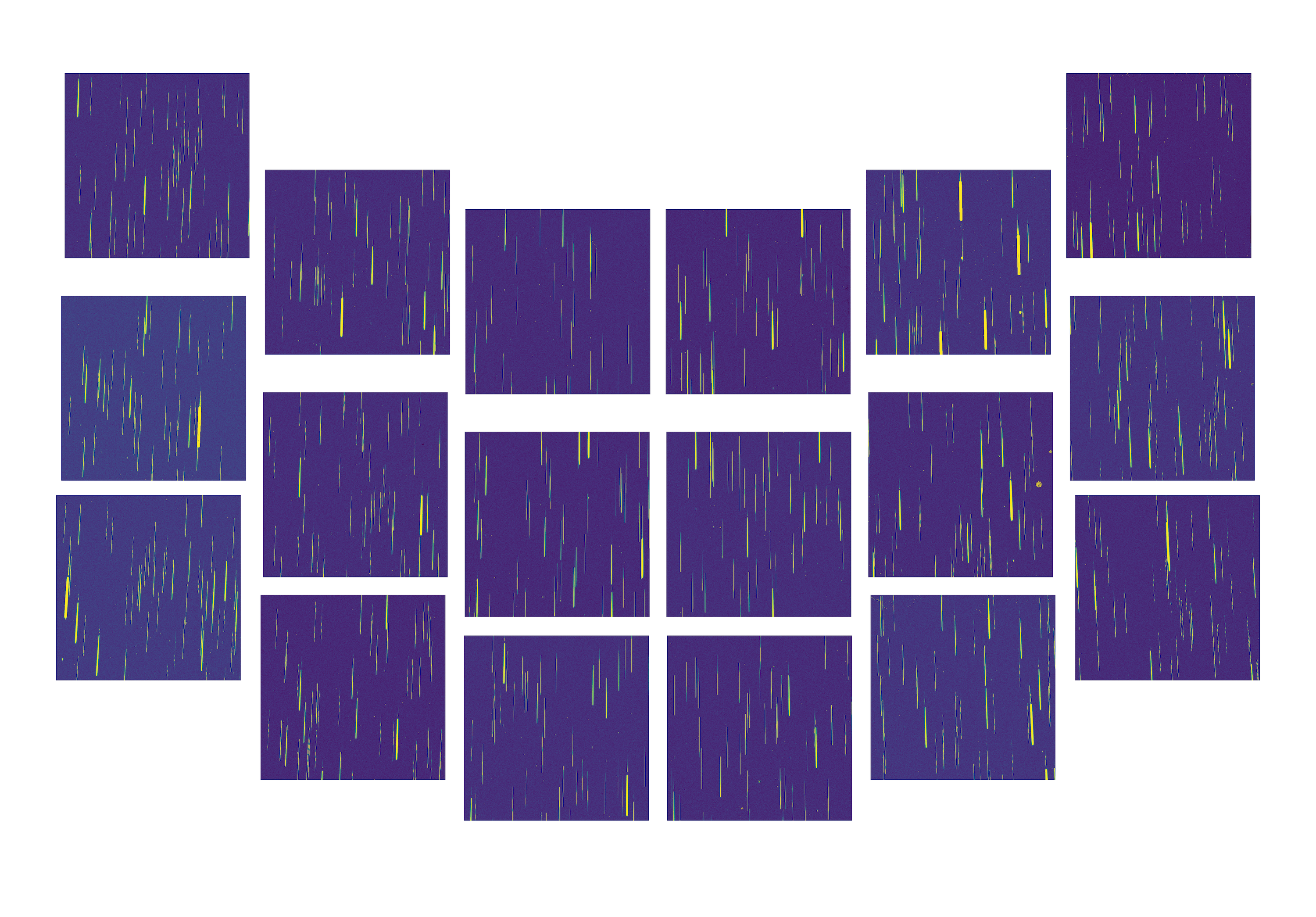
This image shows a simulated spectral observation of Euclid Deep Field North (EDFN) using Roman Wide Field Instrument (WFI) with the grism. The detectors are arranged into the on-sky configuration, which is the Roman WFI footprint. EDFN is one of the calibration fields that the Roman Space Telescope will observe during commissioning and the mission. The calibration pipeline will use the star spectra in the EDFN to refine the optical model and measure any changes with the instrument. Repeated observations of the calibration field will help monitor Roman WFI during its mission.
What do you work on at IPAC?
At IPAC I lead the spectroscopic calibration pipeline development for the Roman Space Telescope. In this role I design and test the calibration pipelines and develop the commissioning and calibration plan for spectroscopy during the mission. The spectroscopy from Roman will be used to study the expansion of the universe and the mysterious dark energy, among other things. Lately we have been participating in Mission Readiness Tests where we practice observing with Roman and try to understand how all of the pieces work together when we are in-flight.
When I am not worrying about calibration for Roman, I am interested in studying the elusive population of dusty, star-forming galaxies. This dusty population has historically been difficult to characterize, but it plays an important role in the star formation history of the universe. It is also a significant contaminant for extremely-high redshift surveys, as their dust-attenuated optical continuum often mimics the Lyman α break of higher-redshift ultraviolet galaxies.
Tell us a funny or memorable story related to your astronomy pursuit
My strange-humorous story is when I was observing at Las Campanas in Chile on one of the Magellan 6.5-meter telescopes. I had just finished observing for the first night of a multi-night run, and it was still quite dark as I wandered back to my dorm room. When I entered my room, I saw what looked like some black fuzz on the floor. I crawled onto the floor to get a closer look at it...up close I realized it was a scorpion. I immediately jumped away from it. I was really at a loss of what to do. I rummaged through the room to see if I could find something to trap it with, while keeping an eye on it to make sure it didn't run away. Fortunately, I stumbled upon a large heavy water glass in the bathroom. I immediately covered the scorpion with the glass. It was captured but I was also really tired. I convinced myself that I could go to bed and take care of it when I woke up; there was no way a scorpion was going to move that heavy glass. So I went to bed... or so I thought.
I laid in bed for a long time and my brain kept thinking about the scorpion. Eventually I couldn't take it anymore. I had to get up and take care of it so I can sleep, but how am I going to get it out of my room? I made a pass through the room looking for something flat that I could slide under the glass. Eventually I found a sheet of paper. I got back down on the floor and carefully slid the sheet of paper under the scorpion. I held the top of the glass tightly on the sheet of paper and then I carefully lifted it up so I could carry it outside. I rushed it outside and once I was far enough from the room I tossed the scorpion. I could finally go to sleep. Now, every time I go back to Magellan, I always do a scorpion check of my room.
What would you recommend a youngster who dreams about becoming a scientist should do?
Work hard but be mindful to take care of yourself. It is important to prioritize yourself during this journey. The path you take may not be the one you anticipated when you first started your journey. There are many paths to success, and someone else's path may be different than the one you find. Find good mentors who will push you and support you. Mentorship can come from many levels. Your peers and your professors, people that you work with, and even people outside of your field can guide you on your journey.
What other interests do you have outside of work? How do you balance them with work?
I have too many interests to list, and never enough time to do them all. I enjoy cooking, and I usually can make time for it. I have to eat, right? I enjoy learning new cooking techniques, trying out new dishes, and slowly expanding my two sons’ palates. I also enjoy gardening. It is one of those interests that can be very satisfying and frustrating at the same time. With gardening I feel like the things I do can make a positive impact. Yeah, sometimes things are outside of your control (e.g., insects, weeds) but there are a lot of small things that you can do to grow healthy plants and fruits. It's fun because there is always something new I am learning about the craft. I recently had success growing pineapples, and I'm expanding into trying to learn how to grow fruit trees from cuttings.
Another interest that I always make time for is camping. Our family tries to plan several camping trips every year. It's good to go somewhere to experience the pristine beauty of nature. In addition, it is good to get away from everything⎯obligations, email⎯and not think about them for a bit. It is also another good way to connect with my family without devices.
It can be difficult to balance my interests with work. That is always a struggle. My work is very stimulating, and sometimes it is hard to get away from it. I also have a lot of family demands with my kids, so it helps to set hard limits when I need to step away from my work to focus on them. This year, in particular, it has been extremely challenging to balance my time with Roman launching at the end of August. Since I am participating in commissioning Roman, we know we have to plan a little more carefully around the launch. It is exciting that Roman is launching soon, seeing everyone's hard work culminating with this event, but it also means we'll be extra busy calibrating and collecting Roman data.
Previous Featured Scientist
Vihang Mehta works at IPAC’s Roman Science Support Center where he is developing the pipeline to reduce Wide Field Instrument (WFI) spectral data that will come from NASA’s Nancy Grace Roman Space...