
Alexandra Greenbaum
Assistant Scientist

In this profile, we feature Alexandra (“Alex”) Greenbaum, who leads NASA’s Nancy Grace Roman Space Telescope Coronagraph Data Management System at IPAC’s Roman Science Support Center.
What made you interested in astronomy?
I was always fascinated with astronomy as a kid, despite growing up in the Bronx, New York City with a lot of light pollution. But, luckily for me, science was all around me.
I remember visiting the Museum of Natural History, especially the giant blue whale in the ocean room and the Hayden Planetarium. There is no doubt that museums like these helped get me interested in science and astronomy. I also remember saving newspaper clippings and magazine covers that highlighted some of the early Hubble Space Telescope press releases, especially the Eagle Nebula’s "Pillars of Creation.”
I used to check out books from the library on several popular science theoretical concepts that I did not necessarily understand, but felt were things I wanted to know. Science was also in my family: my father is a physicist, and my parents always supported my curiosity.
Later, as a young adult I pursued physics and engineering but did not plan or expect to study astronomy or work in it professionally. I feel extremely lucky to have found my way into it. It is like a gift to my younger self.
Tell us about your career path.
I studied mechanical engineering and physics at Rensselaer Polytechnic Institute for my bachelor's. During college, I had a summer internship working on an astronomy instrumentation-adjacent project, which motivated me to apply for graduate programs that had both astronomy and applied physics research that interested me. I was admitted to Johns Hopkins University for graduate school.
I didn't quite decide to go into astronomy until I chose my PhD advisor, Anand Sivaramakrishnan, with whom I had worked with one summer when I was an undergraduate. He was working on high-resolution and high-contrast imaging methods to study stellar, sub-stellar and planetary mass companions to stars. He offered me a research appointment to work with him, and the rest is history.
After completing a postdoctoral position at the University of Michigan, I took a detour from astronomy and started a position as technical staff at Draper Laboratory in Cambridge, MA, where I worked on various guidance and navigation projects, including proprietary and sensitive information, which was very new to me. It was a valuable learning experience, but ultimately not a good fit. In particular, I really missed the open and collaborative nature of working in astronomy, which I did not fully appreciate until that point. Very fortunately, a new role opened up at IPAC and I was able to join the staff in 2021, working on the Roman project.
What is your role at IPAC?
My work at IPAC supports the Coronagraph Instrument on the Nancy Grace Roman Space Telescope. The Coronagraph Instrument is a technology demonstration that exercises key technologies needed for an eventual Earth-analog-imaging NASA flagship mission (The Habitable Worlds Observatory, or HWO).
I lead the data management system, which includes processing the raw spacecraft telemetry into astronomer-readable images and executing data processing for the High Order Wavefront Sensing and Control that enables the Coronagraph Instrument's high contrast.
Science-wise, I am interested in stellar-, substellar-, and planetary-mass binaries down to the lowest masses, where the boundaries of stars and planets blur.
Shortly after joining IPAC, I led a paper characterizing the benchmark brown-dwarf companion HD 19467 B using data collected with NASA’s James Webb Space Telescope (JWST) Near Infrared Camera (NIRCam). Benchmark objects are important for testing theoretical models of how the brightness and composition of brown dwarfs and planetary mass objects vary with other parameters like age and mass.
Using one of NIRCam’s coronagraphic masks to block most of the host star’s light, along with wavefront measurements from the observatory, we measured HD 19467 B’s brightness at wavelengths inaccessible to previous instruments and placed stronger constraints on the system’s age and mass. I am currently involved in the campaign to vet and characterize reference stars for the Roman Coronagraph Instrument, work that will also be valuable for HWO. I am also involved in JWST programs to study brown dwarf and planetary mass objects.
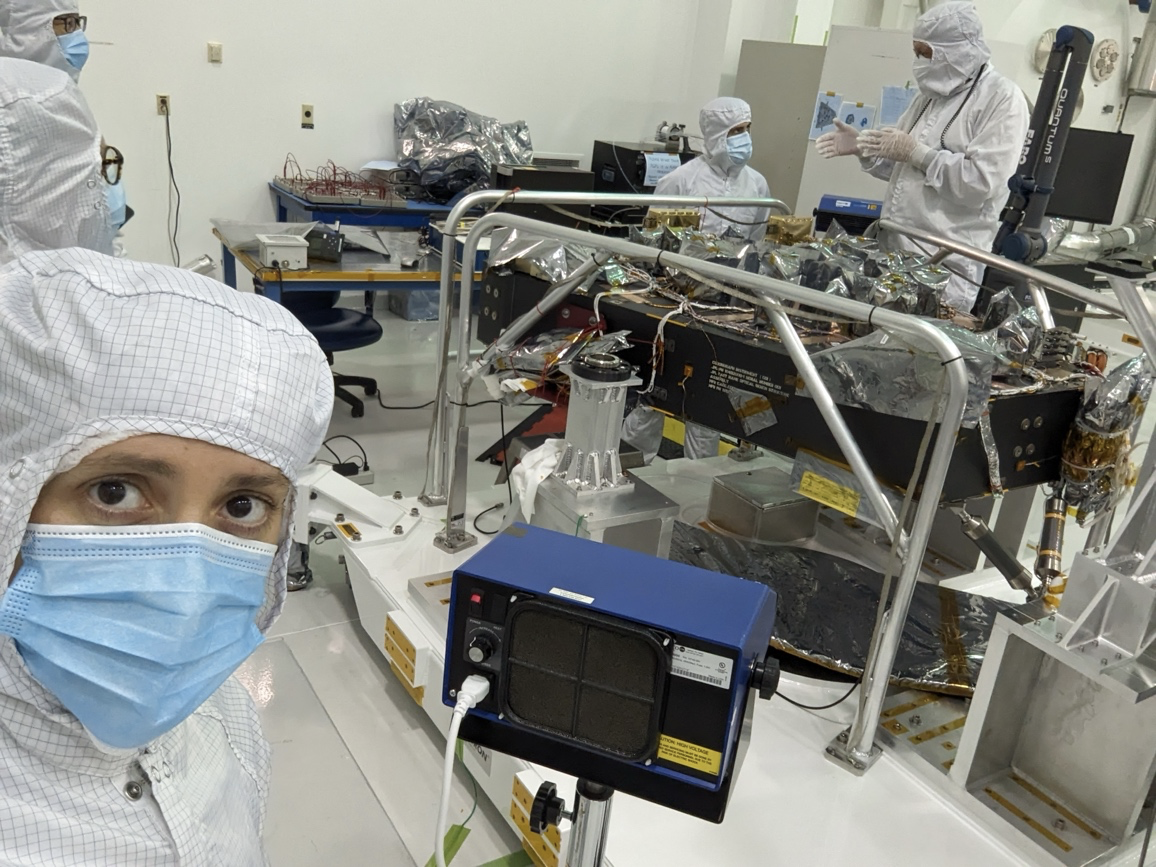
Alexandra Greenbaum (foreground, left) takes a selfie during a tour of the Coronagraph Instrument in the clean room at NASA’s Jet Propulsion Laboratory (JPL). In the background, the optical components are covered on the optical bench portion of the instrument. Everyone in the clean room is required to wear special coverings to minimize dust and static. Shortly after this photo was taken, the optics and electronics portions were joined together, and the instrument went through a series of tests at JPL before it was shipped to NASA’s Goddard Space Flight Center in Maryland.
What do you love about IPAC?
IPAC embodies a lot of my favorite aspects of working in astronomy. IPAC is dedicated to serving the community and enabling wide-ranging and wide-reaching science!
I love how IPAC brings together astronomers and developers to solve hard problems and create impactful products across astronomy disciplines. I also really enjoy working with scientists, engineers, and developers together on projects.
I learn a lot from my coworkers, especially on the best practices of software systems, and from those who worked on the operations of NASA’s Spitzer Space Telescope, and I hope I am also contributing to that collective learning environment.
What do you hope to continue learning about, either personally or professionally?
There is so much I would love to learn about from my colleagues at IPAC who have expertise in mission support and data archives. I am particularly interested in learning more about the early phases of missions, when requirements and work plans are developed. I hope to apply that knowledge to the future missions that IPAC and I will be involved in.
How do you balance work and life?
When I am at work, I try to keep in mind what my long-term priorities are and break down short-term tasks to address those. I have found it helpful to keep track of all the things I work on throughout the day to help evaluate where I spend my work time and how well it is addressing my responsibilities. I take advantage of tools we have at IPAC, such as the JIRA ticketing system for tracking tasks with my team and Confluence for keeping useful notes and information in a centralized place.
Personally, I also keep a daily planner that includes the highest-priority tasks. There are always new things that pop up that can take my attention away, and this helps me keep my focus on priorities while at work by keeping a record of what I am doing from day to day. Then, I know that I can disconnect from work at the end of the day or week.
What do you enjoy doing outside of work?
I love to swim! Most often in pools, but occasionally in the ocean. Sometimes when I swim, I can figure out problems at work, unintentionally.
I've also gotten to enjoy a lot of hiking in Southern California. There are so many trails in and around Pasadena to explore.
The thing I spend the most time on now outside of work, however, is parenting a young toddler! I look forward to the time when I can share some of my work and hobbies with my son.
Previous Featured Scientist

In this profile, we feature Kevin Hardegree−Ullman, who supports the NASA Exoplanet Archive at IPAC.
Next Featured Scientist

Vihang Mehta works at IPAC’s Roman Science Support Center where he is developing the pipeline to reduce Wide Field Instrument (WFI) spectral data that will come from NASA’s Nancy Grace Roman Space...