
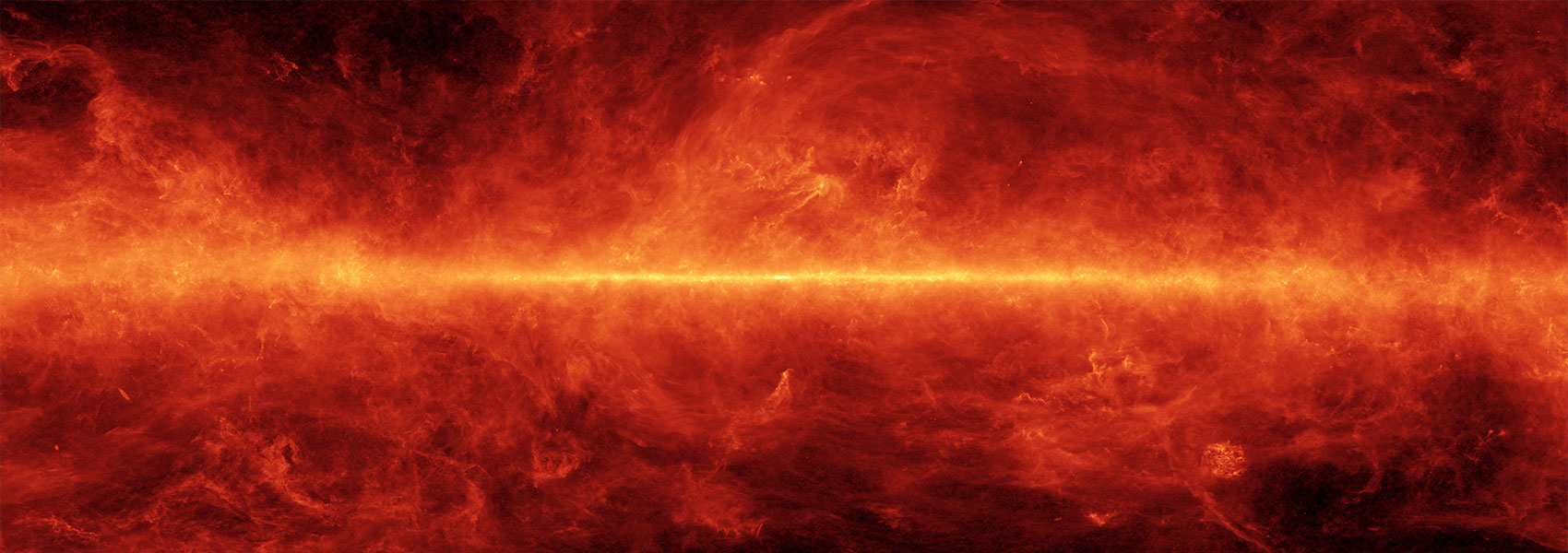
An ultra-high-resolution map of (dark) matter
April 2026 • 2026NatAs..10..573S
Abstract • Ordinary matter—including particles such as protons and neutrons—accounts for only about one-sixth of all matter in the Universe. The rest is dark matter, which does not emit or absorb light but plays a fundamental role in galaxy and structure evolution. Because it interacts only through gravity, one of the most direct probes is weak gravitational lensing: the deflection of light from distant galaxies by intervening mass. Here we present an extremely detailed, wide-area weak-lensing mass map covering 0.77° × 0.70°, using high-resolution imaging from the James Webb Space Telescope as part of the COSMOS-Web survey. By measuring the shapes of 129 galaxies per square arcminute—many independently in the F115W and F150W bands—we achieve an angular resolution of 1.00 ±0.0 1'. Our map has more than twice the resolution of earlier Hubble Space Telescope maps, revealing how dark and luminous matter co-evolve across filaments, clusters and underdensities. It traces mass features out to z ≈ 2, including the most distant structure at z ≈ 1.1. The sensitivity to high-redshift lensing constrains galaxy environments at the peak of cosmic star formation and sets a high-resolution benchmark for testing theories about the nature of dark matter and the formation of large-scale cosmic structure.
Links
- PREPRINT http://arxiv.org/abs/2601.17239
- DATA http://irsa.ipac.caltech.edu/data/COSMOS/
- DATA https://archive.stsci.edu/mastbibref.php?bibcode=2026NatAs..10..573S
- DATA https://exchg.calet.org/cosmosweb-public/DR0.5/
- DATA https://irsa.ipac.caltech.edu/data/COSMOS/
- DATA https://irsa.ipac.caltech.edu/data/COSMOS/gator_docs/cosmos_chandraxid_colDescriptions.html
- ELECTR https://doi.org/10.1038%2Fs41550-025-02763-9