
Ghosts of Eruptions Past: Searching for Historical Galactic Supernovae using Variable Thermal Dust Echoes and Machine Learning
September 2026 • 2026ApJ..1008..207V
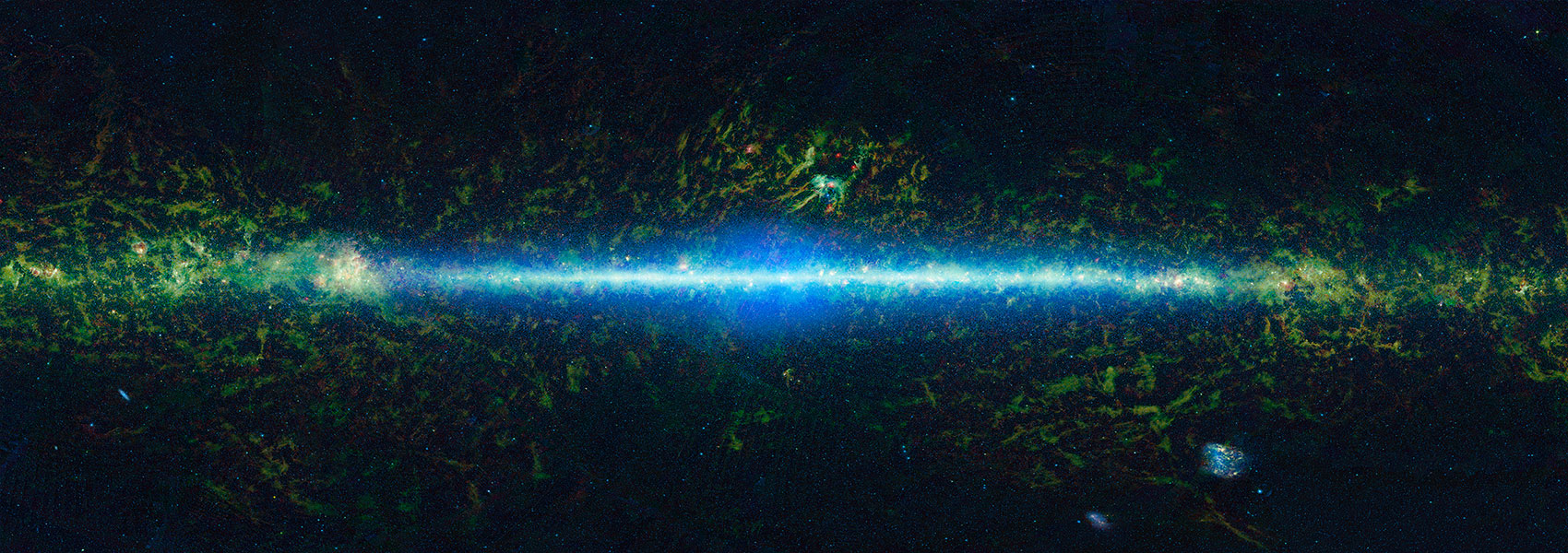
Abstract • The Galactic core-collapse supernova (SN) rate is estimated at ≈1--3 per century; however, no optically visible SN has been discovered in the past 400 yr. Although records of the last optically detected SN (Cassiopeia A) are debated, it is revealed today via its bright, variable mid-infrared (MIR) dust echoes---offering the possibility of identifying dust-obscured, missed events via their dust echoes. We present the first all-sky, untargeted search for thermal dust echoes of luminous Galactic transients using difference imaging on 12 yr of time-resolved NEOWISE coadds (spanning 2009--2022) followed by statistical detection of variable extended sources. We use echo features around Cas A, together with archival catalogs, to train a convolutional neural network to classify transient candidates as dust echoes, point sources, artifacts, and high proper motion stars. Our model achieves ≈94% accuracy in distinguishing echoes from other variable sources. Applying the classifier to ≈11 million transient candidates, we search for spatial overdensities of echoes across the Galactic plane. We find that Cas A is the only region exhibiting echoes at the Wide-field Infrared Survey Explorer (WISE) sensitivity threshold of W2 surface brightness of ≈20 Vega mag arcsec-2---reflecting its unique combination of young age and luminous shock breakout. We present the largest catalog of time-resolved echo positions of Cas A (20,477 within 10∘) that are being used for studies of the surrounding interstellar medium with the James Webb Space Telescope. Our results lay the groundwork for the imminent Roman space telescope surveys---which will achieve ≈100 × higher sensitivity and ≈30 × better spatial resolution at wavelengths of ≲2.5 μm.
Links