
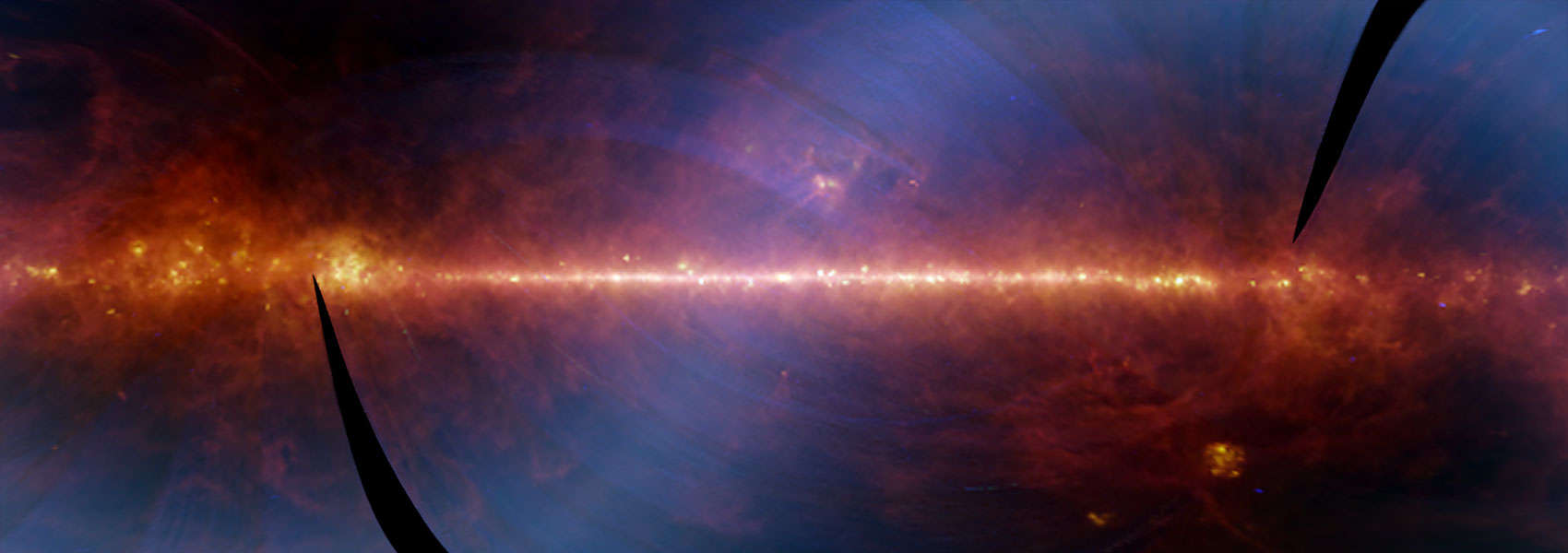
The Serpent Eating Its Own Tail: Dust Destruction in the Apep Colliding Wind Nebula
November 2025 • 2025ApJ...994..121W
Abstract
•
Much of the carbonaceous dust observed in the early Universe may originate from colliding wind binaries (CWBs) hosting hot, luminous Wolf─Rayet (W-R) stars. Downstream of the shock between the stellar winds there exists a suitable environment for dust grain formation, and the orbital motions of the stars wrap this dust into richly structured spiral geometries. The Apep system is the most extreme W-R CWB in our Milky Way: two W-R stars produce a complex spiral dust nebula, whose slow expansion has been linked to a gamma-ray burst progenitor. It has been unclear whether the O-type supergiant 0
Links
- SIMBAD https://simbad.u-strasbg.fr/simbad/sim-ref?querymethod=bib&simbo=on&submit=submit+bibcode&bibcode=2025ApJ...994..121W
- PDF https://iopscience.iop.org/article/10.3847/1538-4357/adfbe1/pdf
- PREPRINT http://arxiv.org/abs/2507.14610
- DATA http://archive.eso.org/bin/ads2eso?2025ApJ...994..121W
- DATA https://archive.stsci.edu/mastbibref.php?bibcode=2025ApJ...994..121W
- DATA https://doi.org/10.17909/mf14-ga19
- DATA https://doi.org/10.5281/zenodo.15875502
- ELECTR https://doi.org/10.3847/1538-4357/adfbe1