
Betelgeuse’s Companion Star May Have Been Seen at Last

Three IPAC scientists, David R. Ciardi, Catherine A. Clark, and Elise Furlan, were co-authors on this study supporting the claim that Betelgeuse may have a stellar companion after centuries of hypothesizing.
"It always amazes me how much we still have to learn. Even stars like Betelgeuse, which we have studied for literally thousands of years, can still surprise us," said Ciardi. "This discovery was enabled by the partnership between NASA and the NSF, and their continued investment in research such as this can help forge similar discoveries in the future for other nearby stars that are prime targets for the Habitable Worlds Observatory."
Astronomers may have directly imaged a companion star to the famous red supergiant Betelgeuse at last. Though the tentative detection only loosely constrains the star’s physical properties, it appears to be a 1.6-solar-mass pre-main-sequence star. The discoverers suggest the name Siwarha, Arabic for “Her Bracelet,” given that the star circles Betelgeuse, “Hand of the Giant.”
Betelgeuse in the Spotlight

A photograph of the constellation Orion. Betelgeuse is the bright yellow star located left of center. Credit: E. Slawik/NOIRLab/NSF/AURA/M. Zamani; CC BY 4.0
Situated at the shoulder of the constellation Orion, the red supergiant Betelgeuse is one of the most recognizable stars in the night sky. It’s also the subject of countless scientific studies and amateur observations that stretch back for centuries.
Betelgeuse is a variable star. On top of its well-constrained 400-day pulsation period, the star has exhibited two behaviors that have drawn interest in recent years: a deep, prolonged dimming episode in 2019–2022 that is thought to be due to an immense ejection of mass from the star’s surface, and a 6-year variation in the star’s photometry, astrometry, and radial velocity.
Multiple studies have attributed the 6-year variability to one or more companion stars. In general, these studies predict that the companion star circles Betelgeuse on a tight, 6-year, nearly edge-on orbit. As reported in a new article published in the Astrophysical Journal Letters, observations have likely proved these predictions correct.
Speckle Detection
Steve Howell (NASA Ames Research Center) and collaborators searched for Betelgeuse’s predicted companion star using the 8.1-meter Gemini North telescope. The team used the ‘Alopeke instrument in speckle imaging mode, which involves taking thousands of milliseconds-long snapshots to avoid smearing due to atmospheric fluctuations.
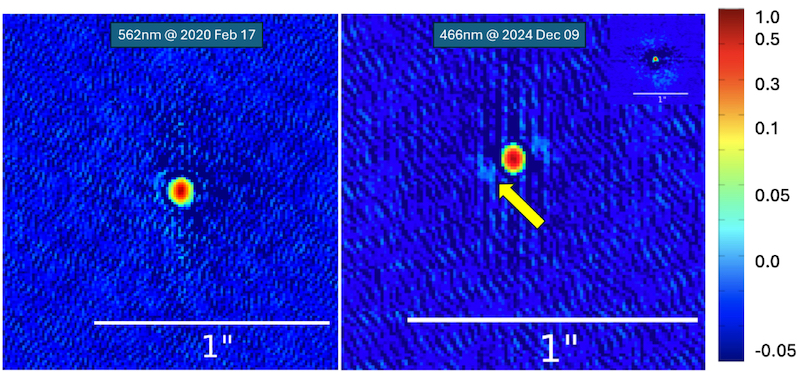
Observations of Betelgeuse from 2020 (left) and 2024 (right). An arrow points to the companion. Note that the image processing introduces a 180º ambiguity in the location of the companion, which is resolved by analyzing phase information. Credit: Howell et al. 2025
The team imaged Betelgeuse in 2020 and 2024. The 2020 observations coincided with when the companion star was predicted to lie behind Betelgeuse from our vantage point, and no companion appears in these images. The 2024 observations were taken just a few days after the companion’s predicted greatest angular separation from the star — and show evidence for a star just beside Betelgeuse.
More to Learn
Howell and coauthors performed additional analyses to rule out interference from hot pixels, cosmic rays, or atmospheric diffraction. They also considered that the star could lie in the background or foreground, but they found both possibilities unlikely. After further calculations, the team estimated that the companion is six magnitudes fainter than Betelgeuse and separated by just 52 milliarcseconds at an angle of 115º. These quantities agree well with predictions for the companion’s position.

The on-sky proper motion of Betelgeuse from 2020 to 20204. The companion is shown as the small black circle. This shows that if the companion star were actually a background star, it would have been plainly visible in the 2020 observations. Credit: Howell et al. 2025
Given the tentative detection — at the level of 1.5σ — it’s difficult to pin down the properties of the companion star. The team placed the star’s mass between 1.4 and 2.0 solar masses, with the likeliest value being 1.6 solar masses. If the companion has the same age as Betelgeuse, this star would be on the cusp of joining the main sequence. However, it may never reach that stage of life; Betelgeuse’s demise in a core-collapse supernova is imminent, in the astronomical sense, and the companion may spiral in to merge with Betelgeuse even before then. (It currently orbits at just 4 au — closer than the distance between the Sun and Jupiter.)
The team closed with a call to the community to turn their instruments toward Betelgeuse on 26 November 2027, when the companion will once again be at its greatest angular separation. Our exploration of this long-sought-after star has just begun!
Citation
“Probable Direct Imaging Discovery of the Stellar Companion to Betelgeuse,” Steve B. Howell et al 2025 ApJL 988 L47. doi:10.3847/2041-8213/adeaaf
- Date: July 24th, 2025
- Category: Project News
- View Image