Chris Gelino
Associate Scientist

This profile series introduces scientists who support projects at Caltech/IPAC while carrying out their own scientific research.
In this profile, we feature Chris Gelino, who works on both the Near-Earth Object Surveyor (NEOS) and the Keck Observatory Archive (KOA) at IPAC.
1. How did it all begin? What ignited the love of astronomy in you? Did you have other dream jobs?
I grew up in a small town in rural Illinois about 45 miles south of Chicago and have always loved discovering things. I guess I have a thing for ancient, unwritten history because I knew early on that I either wanted to be an astronomer or an archeologist. When I realized a career in archaeology wouldn't be like Indiana Jones, my enthusiasm for that job waned. On the other hand, movies like Star Wars and The Last Starfighter got me thinking about how large our universe is and how much of it is undiscovered. Seeing and reading about these fantastical worlds in a galaxy far, far away instilled a desire to find worlds like that in our own galaxy. I wanted to discover something and a career in astronomy seemed like the best way to do that.
2. How did you go about pursuing your dreams regarding astronomy? What was your career path?
Except for a yearlong break⎯during which I worked at a company that researched and propagated corn⎯between earning my Bachelor of Science at the University of Illinois and the start of graduate school at New Mexico State University, the path to my Ph.D. was pretty normal. The department at New Mexico State was attractive because they had access to a big telescope! I loved my time in Las Cruces. They had a lot of nice hiking trails on mountains that were easily reached.
For my Ph.D. dissertation I studied the brightness variability of brown dwarfs (objects with masses between stars and planets). The field was young at the time, so the number of known brown dwarfs was small but growing. To help me keep track of them, I created a catalog of the discoveries, first just for myself, but then for anyone worldwide once others expressed interest in it. I went to a small conference to present some preliminary results of my work, and met with several brown dwarf researchers, including Davy Kirkpatrick from IPAC. We discussed the science of my project and the online catalog I had created.
As I was finishing up my dissertation, I was starting to look for postdoc positions. I don't recall how this conversation was initiated, but Davy had mentioned he was on a project in development (the Space Interferometry Mission or SIM) and their group at Caltech and JPL was looking for someone to compile a list of stars and their properties that could be used as either targets or calibration stars. They wanted something like my online catalog but geared toward this project. I interviewed with Mike Shao (Principal Investigator for the research project) and Shri Kulkarni, they offered me a postdoc position at Caltech, and I accepted.
After a few years working on SIM, I applied for a staff position with the Spitzer Science Center next door and got a job with the science user support team. From there it was the Wide-field Infrared Survey Explorer (WISE), which gave me candidates to search for binary brown dwarfs using the Keck telescopes (I have found probably around 10 of them), the Large Binocular Telescope Interferometer (LBTI), NEOWISE, KOA, NEOS and several other projects over the years. I have also used the Keck telescopes several times, as well as the Gemini telescopes.
My 22+ years at Caltech and IPAC can be rooted back to a catalog I made as a graduate student to help me keep track of some objects in the sky!
3. Tell us about the functional and scientific work that you are engaged in at IPAC. What is your favorite thing about the work you do?
Currently I am the Archive Scientist for the KOA and a Quality Assurance (QA) Scientist for the NEOS. With KOA, I am responsible for ensuring our documentation and data access services are usable and understandable for novice and experienced users. I also coordinate with other scientists who want to contribute data to the archive for others to use and help users with any science or instrument questions.
I just recently started working on the NEOS project, so most of my day-to-day tasks include reading documentation and reviewing the plans and tools for NEOS QA. From now until launch (scheduled no earlier than September 2027), the QA team will be optimizing the tools we will use to check the quality of the data and to assess the tracklets (snippets of an object's path in the sky) of solar system objects.
My favorite part about KOA is making sure our users have what they need to get the science they want out of the data. After all, if our data are not useful for others, then there is no reason to serve them. For NEOS, it's exciting to be part of something new and helping to shape even just a small part of the project.
My scientific interests are in brown dwarfs and nearby stars. In particular, I enjoy using high-resolution imaging to find companions to objects; it's an amazing feeling to be observing and see a new binary appear in the image you just took.
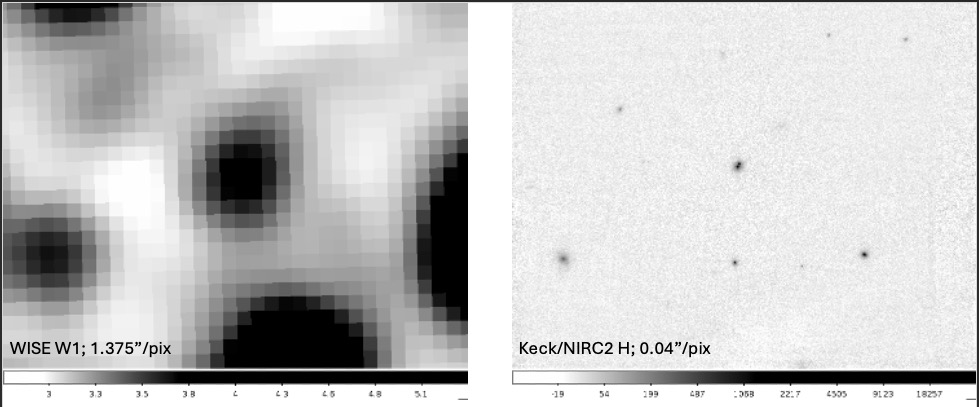
WISE/NEOWISE scanned the entire sky multiple times and was very good at discovering brown dwarfs. However, to be efficient at these observations, the WISE pixels needed to cover a relatively large area of the sky. This meant that the light from many objects could blend to appear as a single object. When we found new brown dwarfs in WISE/NEOWISE data, the images would make it appear that the brown dwarf was a single object (left image). Often, it actually was a single brown dwarf. But for about 10%−20% of the discovered brown dwarfs, high resolution images like those with the NIRC2 instrument on the W.M. Keck Telescope (right image) would show that the brown dwarf was really two brown dwarfs! These binaries are crucial for our understanding of brown dwarfs because they allow us to eventually measure the masses of these objects, something that is not possible for single brown dwarfs.
4. What is your favorite memory from your career?
My favorite memory happens to be a recent one. In April 2024, the path of the total solar eclipse passed within a three-hour drive from my parents' home in Illinois. Neither I nor my parents had experienced a total solar eclipse, so I planned to head to Illinois and take a road trip with them into the path of totality.
From talking with others who had traveled to see a total eclipse, I knew to expect lots of traffic into and out of the path of totality. I checked out locations close to my parents' hometown that were away from major towns and avoided the major highways, hoping that would mean less traffic. Scanning through Google Maps, I found a park in the small town of West Union, IL (population less than 300) that looked perfect. The cloud cover prediction wasn't great for that location, and it was slightly better towards Indianapolis, IN, which was a similar distance away. We took a chance with the clouds and headed to West Union since we expected better traffic going there than toward Indianapolis. We were not disappointed! We had minimal traffic, and the clouds cleared away in time for the eclipse to start. The totality was as incredible as everyone had told me⎯a very surreal experience.
However, what made the event even more special than just a total eclipse, was spending the time with my parents and giving back to them a part of the knowledge that their hard work allowed me to study.
5. What do you love most about IPAC and its people?
What I love about IPAC is its people and how helpful everyone is. On the work side, you can walk into almost anyone's office, ask for help, and get that help! This helpfulness extends beyond the project work and was on full display earlier this year after the devastating fires in the area. The way that everyone came together to help those who needed it was inspiring.
6. What do you like to do outside of your job, in your free time?
Softball! Whether it's my own slow-pitch team or being an assistant coach for my daughter's travel ball team, I spend a lot of time at softball fields. One great thing about southern California is that the weather is amenable for outdoor sports like softball year-round. Most travel teams take advantage of this and will have practices and/or games nearly every week, except for when high school teams are in season. I wouldn't say I "like" getting up early on the weekends, but I do enjoy helping the team. I used to play in the IPAC slow-pitch softball team for many years as well.
The other things I enjoy doing after work include cooking and playing on my PlayStation. I'm not very creative when I cook, but if you give me a recipe and it looks like something I'll enjoy eating, then I'll make it. I'll make everything from Indian to BBQ to cheesecake. My favorite dish I make is butter chicken, which I think bests some restaurant versions. With the PlayStation, it's a good way to unwind at the end of the day and get lost in some fantastical world. Given that I enjoy the discovery part of astronomy, it is probably no surprise that I like games where I can wander around and find the things that the game developers left for the players.
7. Do you have any advice for aspiring astronomers or those who want to work at IPAC someday?
This is primarily addressed to undergraduate and graduate students: talk to people! Start with your department and talk to the professors, particularly the ones that work in a field that interests you. Get to know what they do. If you want to be an observer, ask if they have any remote observing runs that you could sit in on and watch the process. Go to any of the colloquia your department holds and talk to the speakers, if given the opportunity, especially if they are talking about future projects. Doing this has several benefits: 1. if you are introverted, it gets you talking to people in what should be a relaxed, no pressure environment; 2. it broadens your astronomy knowledge in a way that classwork may not; 3. it plants seeds in others that may sprout into an important opportunity later.
Previous Featured Scientist

In this profile, we feature Tiffany Meshkat, who initially joined IPAC as a staff scientist in the Roman project in 2017. She is now working for both the Euclid NASA Science Center at IPAC (ENSCI)...
Next Featured Scientist

In this profile, we feature Kevin Hardegree−Ullman, who supports the NASA Exoplanet Archive at IPAC.