Headlines
Observations from NASA's Wide-field Infrared Survey Explorer (WISE) have led to the best assessment yet of our solar system's population of potentially hazardous asteroids. The results reveal new information about their total numbers, origins and the possible dangers they may pose.
Images from NASA's Wide-field Infrared Survey Explorer (WISE) reveal an old star in the throes of a fiery outburst, spraying the cosmos with dust. The findings offer a rare, real-time look at the process by which stars like our sun seed the universe with building blocks for other stars, planets and even life. The star, catalogued as WISE J180956.27-330500.2, was discovered in images taken during the WISE survey in 2010, the most detailed infrared survey to date of the entire celestial sky. It stood out from other objects because it glowed brightly with infrared light. When compared to images taken more than 20 years ago, astronomers found the star was 100 times brighter.
The WISE all-sky image is now available for projection on "Science on a Sphere" (see http://sos.noaa.gov/ for info). Science On a Sphere is a large visualization system that uses computers and video projectors to display animated data onto the outside of a sphere. Said another way, SOS is an animated globe that can show dynamic, animated images of the atmosphere, oceans, and land of a planet.
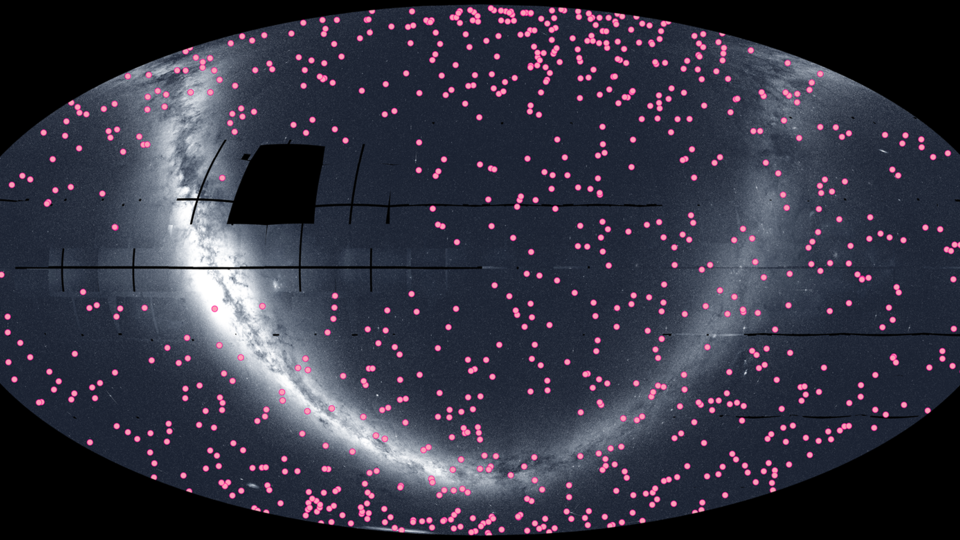
NASA unveiled a new atlas and catalog of the entire infrared sky today showing more than a half billion stars, galaxies and other objects captured by the Wide-field Infrared Survey Explorer (WISE) mission.
New observations by NASA's Wide-field Infrared Survey Explorer, or WISE, show there are significantly fewer near-Earth asteroids in the mid-size range than previously thought. The findings also indicate NASA has found more than 90 percent of the largest near-Earth asteroids, meeting a goal agreed to with Congress in 1998.
Astronomers using NASA's Wide-field Infrared Survey Explorer (WISE) have captured rare data of a flaring black hole, revealing new details about these powerful objects and their blazing jets.
Bulletins
They say there is no place like home. For Caltech's George Helou, the essence of that phrase carries over to the recognition of his accomplishments. This past year, he has received numerous honors from Lebanon, his country of origin, including his election to the Lebanese Academy of Sciences. The tributes bestowed by the Mediterranean nation cite Helou's distinguished career in astronomy in the United States and Europe.
Our Milky Way galaxy contains a minimum of one planet for every star on average, according to a new statistical study.
Imagine you are a high school student walking into your science class in September and you learn that your teacher is doing research with NASA and you can actually participate This experience is occurring in schools around the US as more and more teachers become part of the NASA/IPAC Teacher Archive Research Program. 2012 marks the program's 8th year.
Today, astronomers unveiled the most complete 3-D map of the local universe (out to a distance of 380 million light-years) ever created. Taking more than 10 years to complete, the 2MASS Redshift Survey (2MRS) also is notable for extending closer to the Galactic plane than previous surveys - a region that's generally obscured by dust.
NASA announced Monday an $18.7 billion budget request for fiscal year 2012 that supports a reinvigorated path of innovation, technological development and scientific discovery. The budget supports all elements of NASA's 2010 Authorization Act, which was passed by a strong bipartisan majority of Congress and signed into law by President Obama.
The NASA/IPAC Teacher Archive Research Program class of 2011 was recently announced. A total of 12 educators hail from all over the United States including Arizona, California, Connecticut, Florida, Illinois, Kansas, Minnesota, Oregon, Pennsylvania, Virginia, and Wisconsin. The educators and their scientific mentors are divided into three teams that will perform research and prepare posters for the 2012 American Astronomical Society winter conference.