The Infrared Space Observatory (ISO) will operate at wavelengths from 2.5 to over 200 um, providing astronomers with an unequalled tool for exploring the universe from objects in the Solar System to galaxies and quasars at large redshifts. The ISO telescope is a Ritchey-Chrétien design with a 60 cm effective-aperture primary and a fixed secondary, both liquid-helium cooled to around 3 K. The mirrors are of adequate quality for diffraction-limited performance at 5 um. The focal plane carries four instruments, each of which views a 3' unvignetted field centered 8.5' away from the telescope optical axis.
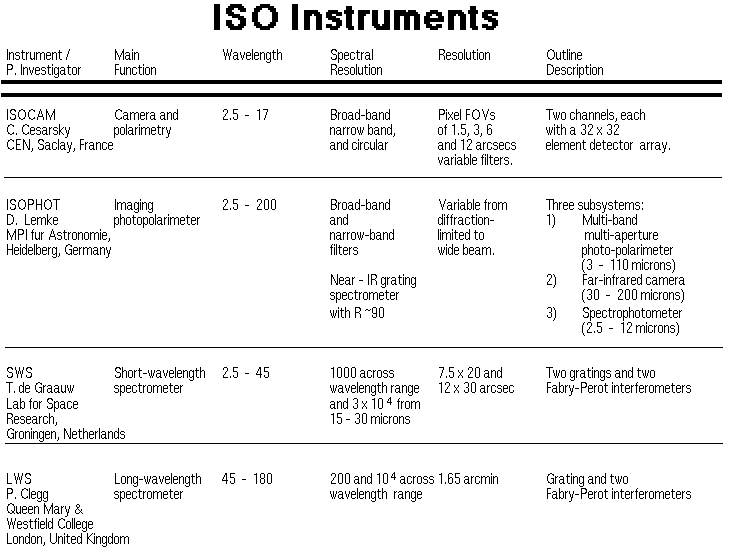
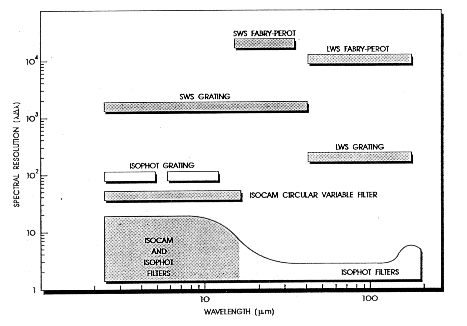
Figure 1, adapted from Martin Kessler's article in reference (1), gives an overview of the spectral coverage and resolution available on ISO. Table 1, adapted from the same reference, gives more detail on spatial resolution and various modes of the instruments. The last column in Table 1 lists representative values of typical expected sensitivities. However, these entries are indicative only, and one should verify whether ISO can accomplish specific observations by using detailed documentation from the ISO Project, available by way of IPAC.
The ISO spacecraft will be three-axis stabilized to an accuracy of a few arcseconds. It will operate in a high eccentricity 24 hour orbit, with perigee at 1,000 km, apogee at 70,000 km, and a 5 degree inclination to the Equator. Because of the Earth's radiation belts however, only 16 to 17 hours of each orbit will be useful for scientific operations. The Sun and Earth avoidance constraints lead to an uneven sky coverage during the ISO mission, including one part of the sky that will remain out of ISO's reach even after a whole year in orbit. The location of this blind spot on the sky depends on the launch date; the current expectation is that the blind spot will unfortunately either be in the Orion region or in the Galactic Center region.
ISO is scheduled for launch in September 1995; its liquid helium reserves are expected to last at least 18 months. During this period, ESA will make about two-thirds of the observing time available to the general astronomical community by soliciting proposals and selecting among them by peer review. For more information on the ISO mission, or detailed data on the science capabilities, please send e-mail to iso@ipac.caltech.edu